Synthesis of Polybenzoxazine as an environmentally friendly adhesive material from cardanol and post-consumer PET source
Author affiliations
DOI:
https://doi.org/10.15625/2525-2518/18526Keywords:
Cardanol, benzoxazine, post-consumer Polyethylene terephthalate, adhesiveAbstract
In this study, a thermosetting benzoxazine was successfully prepared from environmentally friendly sources to be used as an adhesive. The phenolic component used for the synthesis of the benzoxazine monomer is cardanol derived from the cashew nutshell, while the amine fractions are terephthalamide, which is a product of the amination process of used polyethylene terephthalate plastic bottles (PET). The structure of the benzoxazine monomer was determined by FT-IR and 1H-NMR spectroscopy. The thermal and curing behavior of the materials was investigated by differential scanning calorimetry (DSC) and thermogravimetric analysis (TGA). A lap-shear adhesion testing (ASTM D1002-10) was performed to measure the bond strength of the material to the CT3 steel surface. The adhesive properties with a shear strength of 7.29 MPa are excellent compared to other commercial adhesives. This result indicates the great potential of this benzoxazine for adhesive applications in practice.
Downloads
References
1. Kinloch A. J., Kinloch A. J. - Adhesion and adhesives: science and technology, Springer Science & Business Media, 1987.
2. Banea M. D., da Silva L. F., Campilho R. D., Sato C. - Smart adhesive joints: An overview of recent developments, The Journal of Adhesion 90 (1) (2014) 16-40. https://doi.org/10.1080/00218464.2013.785916
3. Onusseit H., Wefringhaus R., Dreezen G., Wichelhaus J., Schall J., Thiele L., van Halteren A. - Adhesives 1. general, Ullmann's Encyclopedia of Industrial Chemistry, 2010, 440-481.https://doi.org/10.1002/14356007.a01_221.pub3
4. Van K. N. - Chemical and technological adhesive, Publisher of Vietnam Academy of Science and Technology, 2006.
5. Schmidt R. G., Bell J. P. - Epoxy adhesion to metals, Epoxy resins composites II 2005, 2005, pp. 33-71.
6. Nečasová B., Liška P., Kelar J., Šlanhof J. - Comparison of adhesive properties of polyurethane adhesive system and wood-plastic composites with different polymers after mechanical, chemical and physical surface treatment, Polymers 11 (3) (2019) 397. https://doi.org/10.3390/polym11030397
7. Leggat P. A., Smith D. R., Kedjarune U. - Surgical applications of cyanoacrylate adhesives: a review of toxicity, ANZ journal of surgery 77 (4) (2007) 209-213. https://doi.org/10.1111/j.1445-2197.2007.04020.x
8. Sharma P., Lochab B., Kumar D., Roy P. K. - Sustainable bis-benzoxazines from cardanol and PET-derived terephthalamides, ACS Sustainable Chemistry & Engineering 4 (3) (2016) 1085-1093. https://doi.org/10.1021/acssuschemeng.5b01153
9. Voirin C., Caillol S., Sadavarte N. V., Tawade B. V., Boutevin B., Wadgaonkar P. P. - Functionalization of cardanol: towards biobased polymers and additives, Polymer Chemistry 5 (9) (2014) 3142-3162. https://doi.org/10.1039/C3PY01194A
10. Mohapatra S., Nando G. B. - Cardanol: a green substitute for aromatic oil as a plasticizer in natural rubber, Rsc Advances 4 (30) (2014) 15406-15418. https://doi.org/ 10.1039/C3RA46061D
11. A Attanasi O., S Behalo M., Favi G., Lomonaco D., E Mazzetto S., Mele G., Pio I., Vasapollo G. - Solvent free synthesis of novel mono-and bis-benzoxazines from cashew nut shell liquid components, Current Organic Chemistry 16 (21) (2012) 2613-2621. https://doi.org/10.2174/138527212804004616
12. Wang X., Yu L., Liu Y., Jiang X. - Synthesis and fouling resistance of capsaicin derivatives containing amide groups, Science of the Total Environment 710 (2020) 136361. https://doi.org/10.1016/j.scitotenv.2019.136361
13. Hoang C. N., Dang Y. H. - Aminolysis of poly (ethylene terephthalate) waste with ethylenediamine and characterization of α, ω-diamine products, Polymer degradation and stability 98 (3) (2013) 697-708. https://doi.org/10.1016/j.polymdegradstab.2012.12.026
14. Khan M. M., Halder K., Shishatskiy S., Filiz V. - Synthesis and crosslinking of polyether-based main chain benzoxazine polymers and their gas separation performance, Polymers 10 (2) (2018) 221. https://doi.org/10.3390/polym10020221
15. Tuong H. K. - Investigation of Benzoxazine resin derived from cardanol on the properties of natural rubber compounds, Thesis, 2023, pp. 28-34.
Downloads
Published
How to Cite
Issue
Section
License

This work is licensed under a Creative Commons Attribution-ShareAlike 4.0 International License.
Vietnam Journal of Sciences and Technology (VJST) is an open access and peer-reviewed journal. All academic publications could be made free to read and downloaded for everyone. In addition, articles are published under term of the Creative Commons Attribution-ShareAlike 4.0 International (CC BY-SA) Licence which permits use, distribution and reproduction in any medium, provided the original work is properly cited & ShareAlike terms followed.
Copyright on any research article published in VJST is retained by the respective author(s), without restrictions. Authors grant VAST Journals System a license to publish the article and identify itself as the original publisher. Upon author(s) by giving permission to VJST either via VJST journal portal or other channel to publish their research work in VJST agrees to all the terms and conditions of https://creativecommons.org/licenses/by-sa/4.0/ License and terms & condition set by VJST.
Authors have the responsibility of to secure all necessary copyright permissions for the use of 3rd-party materials in their manuscript.




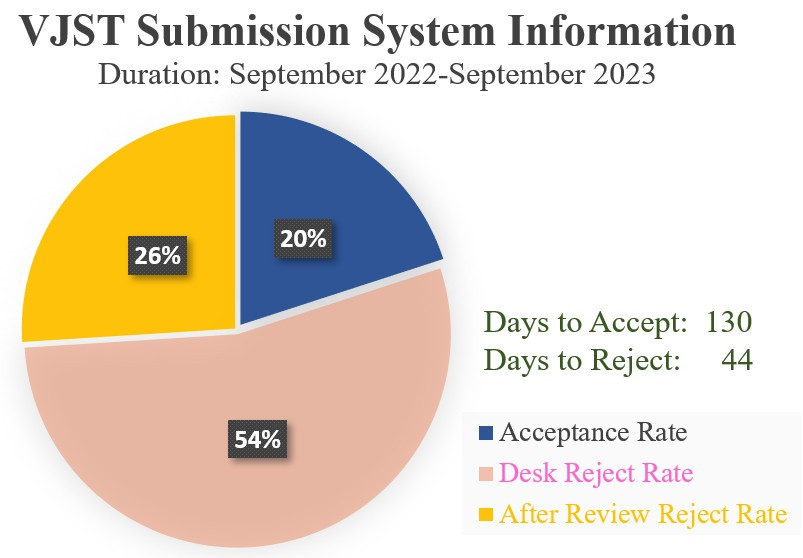
 Vietnam Journal of Science and Technology (VJST) is pleased to notice: