Convergence of complex multi-variables based on fading channels in multi-antenna communication systems
Author affiliations
DOI:
https://doi.org/10.15625/2525-2518/21965Keywords:
wireless communication, MIMO, multi-antenna, fading channelsAbstract
This work introduces approximate expressions and provides comprehensive simulation results to demonstrate the robust convergence of complex variables based on fading channels in multi-antenna communication systems, in which two separate scenarios, namely spatial signal processing and non-spatial signal processing scenarios, were evaluated. Numerical results prove our assertions that for Nakagami-m and Rician fading channels (or can be extended to any other complex fading channels) in multi-antenna systems with antenna numbers larger than two, the distribution of interference from the beamforming design, a typical example for spatial signal processing, and will strongly converge to an exponential distribution with the scale-parameter remaining the same. Meanwhile, the channel synthesis in the non-spatial signal processing scenario tends to an exponential distribution with a new scale parameter exactly equal to the product of the number of antennas and the scale parameter.
Downloads
References
Jiang, W.; Han, B.; Habibi, M.A.; Schotten, H.D. The road towards 6G: A comprehensive survey. IEEE Open Journal of the Communications Society 2021, 2, 334–366.
2. De Alwis, C.; Kalla, A.; Pham, Q.V.; Kumar, P.; Dev, K.; Hwang, W.J.; Liyanage, M. Survey on 6G frontiers: Trends, applications, requirements, technologies and future research. IEEE Open Journal of the Communications Society 2021, 2, 836–886.
3. Alsabah, M.; Naser, M.A.; Mahmmod, B.M.; Abdulhussain, S.H.; Eissa, M.R.; Al-Baidhani, A.; Noordin, N.K.; Sait, S.M.; Al-Utaibi, K.A.; Hashim, F. 6G Wireless Communications Networks: A Comprehensive Survey. IEEE Access 2021, 9, 148191–148243. https://doi.org/10.1109/ 324/ACCESS.2021.3124812.
4. Sefati, S.S.; Halunga, S. Ultra-reliability and low-latency communications on the Internet of things based on 5G network: Literature review, classification, and future research view. Transactions on Emerging Telecommunications Technologies 2023, 34, e4770.
5. Islam, S.; Atallah, Z.A.; Budati, A.K.; Hasan, M.K.; Kolandaisamy, R.; Nurhizam, S. Mobile Networks Toward 5G/6G: Network Architecture, Opportunities and Challenges in Smart City. IEEE Open Journal of the Communications Society 2024.
6. Pons, M.; Valenzuela, E.; Rodríguez, B.; Nolazco-Flores, J.A.; Del-Valle-Soto, C. Utilization of 5G technologies in IoT applications: Current limitations by interference and network optimization difficulties—A review. Sensors 2023, 23, 3876.
7. Antoniewicz, B.; Dreyfus, S. Techniques on Controlling Bandwidth and Energy Consumption for 5G and 6G Wireless Communication Systems. International Journal of communication and computer Technologies 2024, 12, 11–20.
8. Rehman, S.U.; Ahmad, J.; Manzar, A.; Moinuddin, M. Beamforming techniques for MIMO-NOMA for 5G and beyond 5G: Research gaps and future directions. Circuits, Systems, and Signal Processing 2024, 43, 1518–1548.
9. B. Praveen Kumar and U. K. Kommuri, "Review on 5G Small Cell Base Station Antennas: Design Challenges and Technologies," in IEEE Access, 12, pp. 85899-85928, 2024, doi: 10.1109/ACCESS.2024.3415640.
10. Kwak, S.; Kim, J. Central limit theorem: The cornerstone of modern statistics. Korean Journal of Anesthesiology 2017, 70, 144. https://doi.org/10.4097/kjae.2017.70.2.144.
11. Zhang, X.; Astivia, O.L.O.; Kroc, E.; Zumbo, B.D. How to Think Clearly About the Central Limit Theorem. Psychological Methods 2023, 28, 1427–1445. https://doi.org/10.1037/met0000448.
12. Hanif, M.F.; Ding, Z.; Ratnarajah, T.; Karagiannidis, G.K. A Minorization-Maximization Method for Optimizing Sum Rate in the Downlink of Non-Orthogonal Multiple Access Systems. IEEE Transactions on Signal Processing 2016, 64, 76–88. https://doi.org/10.1109/TSP.2015.2480042.
13. Moustakas, A.; Simon, S.; Sengupta, A. MIMO capacity through correlated channels in the presence of correlated interferers and noise: a (not so) large N analysis. IEEE Transactions on Information Theory 2003, 49, 2545–2561. https://doi.org/10.1109/TIT.2003.817427.
14. Jung, M.; Kim, T.; Min, K.; Kim, Y.; Lee, J.; Choi, S. Asymptotic Distribution of System Capacity in Multiuser MIMO Systems with Large Number of Antennas. In Proceedings of the 2013 IEEE 77th Vehicular Technology Conference (VTC Spring), 2013, pp. 1–5. https://doi.org/10.1109/VTCSpring.2013.6692462.
15. López, O.L.A.; Alves, H.; Souza, R.D.; Montejo-Sánchez, S. Statistical Analysis of Multiple Antenna Strategies for Wireless Energy Transfer. IEEE Transactions on Communications 2019, 67, 7245–7262. https://doi.org/10.1109/TCOMM.2019.2928542.
16. Kammoun, A.; Kharouf, M.; Hachem, W.; Najim, J. A Central Limit Theorem for the SINR at the LMMSE Estimator Output for Large Dimensional Signals. IEEE Transactions on Information Theory 2008, 55. https://doi.org/10.1109/TIT.2009.2030463.
17. Hu, J.; Li, W.; Zhou, W. Central Limit Theorem for Mutual Information of Large MIMO Systems With Elliptically Correlated Channels. IEEE Transactions on Information Theory 2019, 65, 7168–7180. https://doi.org/10.1109/TIT.2019.2913760.
18. Ullah, M.S.; Ashraf, Z.B.; Sarker, S.C. Performance Analysis of 6G Multiuser Massive MIMO-OFDM THz Wireless Systems with Hybrid Beamforming under Intercarrier Interference. arXiv preprint arXiv:2401.12351 2024.
19. Gao, M.; Li, Y.; Dobre, O.; Al-Dhahir, N. Blind Identification of SFBC-OFDM Signals Based on the Central Limit Theorem. IEEE Transactions on Wireless Communications 2019, PP, 1–1. https://doi.org/10.1109/TWC.2019.2914687.
20. Hajiabadi, M.E.; Mashhadi, H.R. Analysis of the Probability Distribution of LMP by Central Limit Theorem. IEEE Transactions on Power Systems 2013, 28, 2862–2871. https://doi.org/10.1109/TPWRS.2013.2252372.
Downloads
Published
How to Cite
Issue
Section
License

This work is licensed under a Creative Commons Attribution-ShareAlike 4.0 International License.
Vietnam Journal of Sciences and Technology (VJST) is an open access and peer-reviewed journal. All academic publications could be made free to read and downloaded for everyone. In addition, articles are published under term of the Creative Commons Attribution-ShareAlike 4.0 International (CC BY-SA) Licence which permits use, distribution and reproduction in any medium, provided the original work is properly cited & ShareAlike terms followed.
Copyright on any research article published in VJST is retained by the respective author(s), without restrictions. Authors grant VAST Journals System a license to publish the article and identify itself as the original publisher. Upon author(s) by giving permission to VJST either via VJST journal portal or other channel to publish their research work in VJST agrees to all the terms and conditions of https://creativecommons.org/licenses/by-sa/4.0/ License and terms & condition set by VJST.
Authors have the responsibility of to secure all necessary copyright permissions for the use of 3rd-party materials in their manuscript.




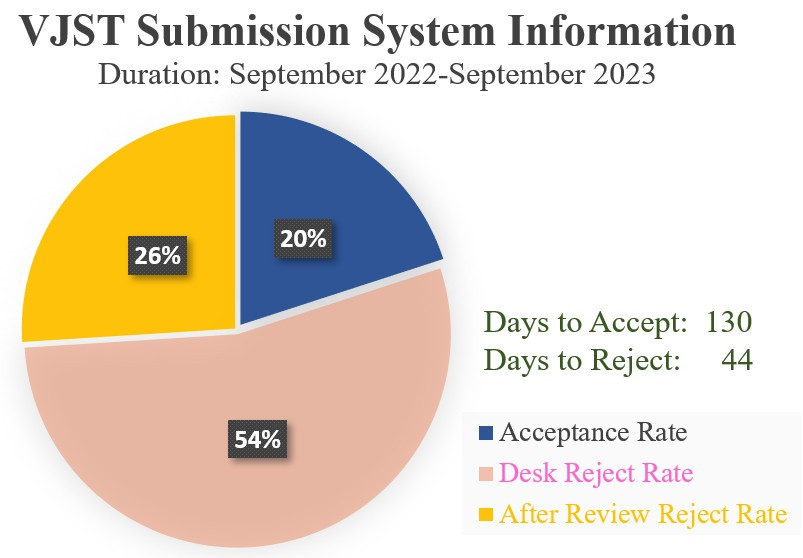
 Vietnam Journal of Science and Technology (VJST) is pleased to notice: